Des Plaines, Illinois | Municipal camera notices
Des Plaines Red Light Cameras: Golf and Rand, Tickets and Payment
Find the right intersection and issuer, understand the documented suspension history, and choose the correct way to view, pay or contest a notice.
A search for Des Plaines red light cameras can lead to three different things: the City of Des Plaines program at Golf and Rand, a street named Des Plaines Avenue in Forest Park, or Chicago's much larger camera map. The differences matter when you are checking equipment, but they matter even more when a mailed notice has a response date. This guide follows the municipal record and explains what to verify before treating a map, portal or older webpage as the answer to your particular event.
Find the Des Plaines program without following the wrong map
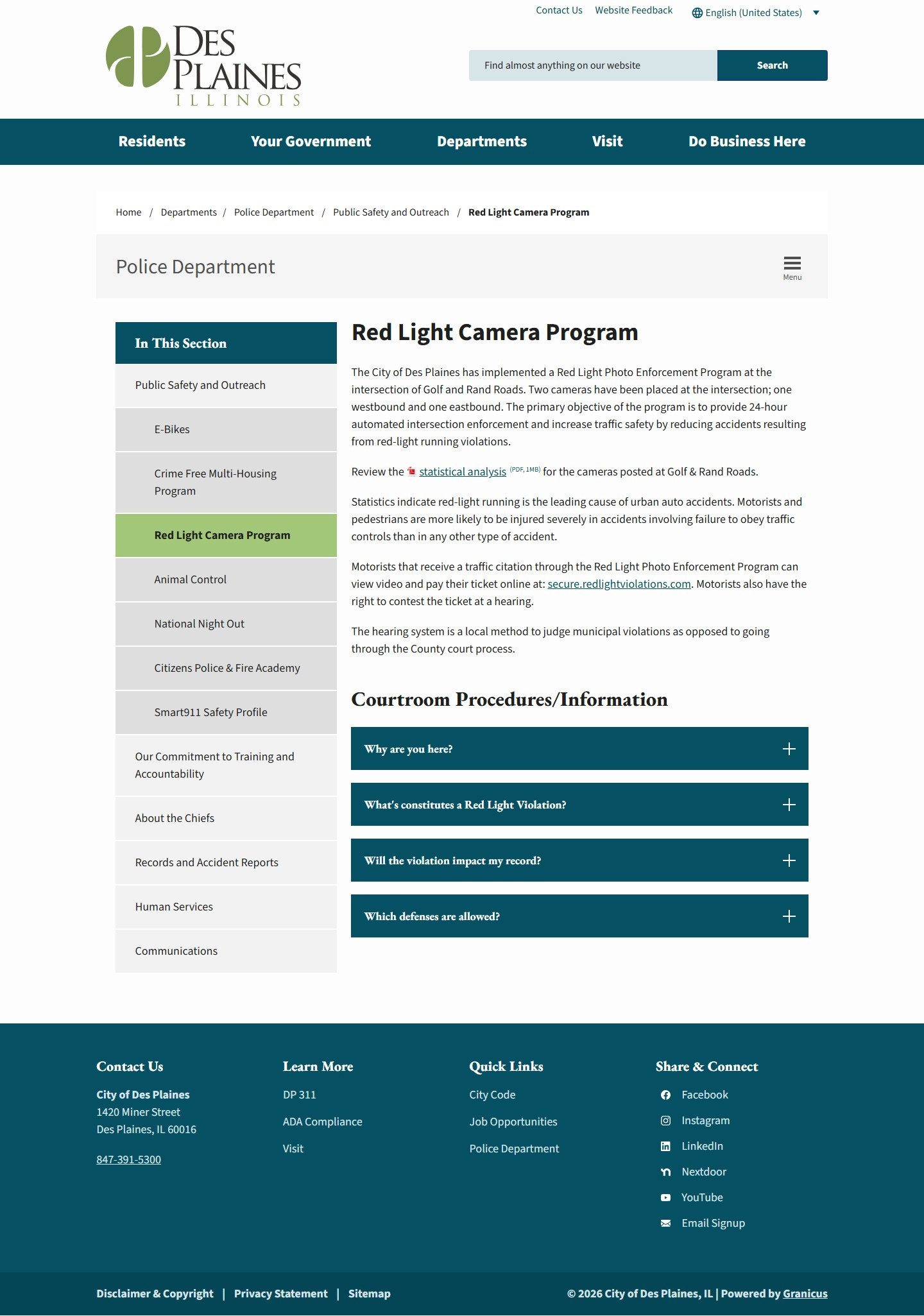
The City of Des Plaines identifies Golf Road at Rand Road as its red-light photo-enforcement intersection, with eastbound and westbound cameras described on its municipal program page. That is the place to start when identifying the city’s equipment. It is not a statement that every approach or every turn at the intersection is monitored.
There is an important timing qualification. A city analysis dated July 29, 2025 labels its 2021–2023 intersection charts with an eastbound/westbound camera suspension associated with an intersection-improvement project. A maintained general program page and a dated suspension report answer different questions. Neither, by itself, establishes a later restart date. If your question is whether equipment is issuing notices on a particular day, ask the municipal program about that date and approach rather than treating an old pin as confirmation.
| Search result or place | What it actually identifies |
|---|---|
| Golf Road and Rand Road | The Des Plaines municipal program’s documented intersection |
| Roosevelt Road and Des Plaines Avenue | A separate Forest Park location, not the City of Des Plaines program |
| Chicago red-light camera map | Chicago city equipment, with different municipal administration |
The street-name trap matters: Forest Park Police lists Roosevelt Road and Des Plaines as a northbound enforcement location. A search engine may surface it for the words “Des Plaines camera,” but its issuer is Forest Park. Match the city printed on your notice, the intersection and the recorded direction together. Our Cook County ticket-lookup guide explains why a county name alone does not identify the right municipal portal.
Understand what the camera evidence is supposed to show
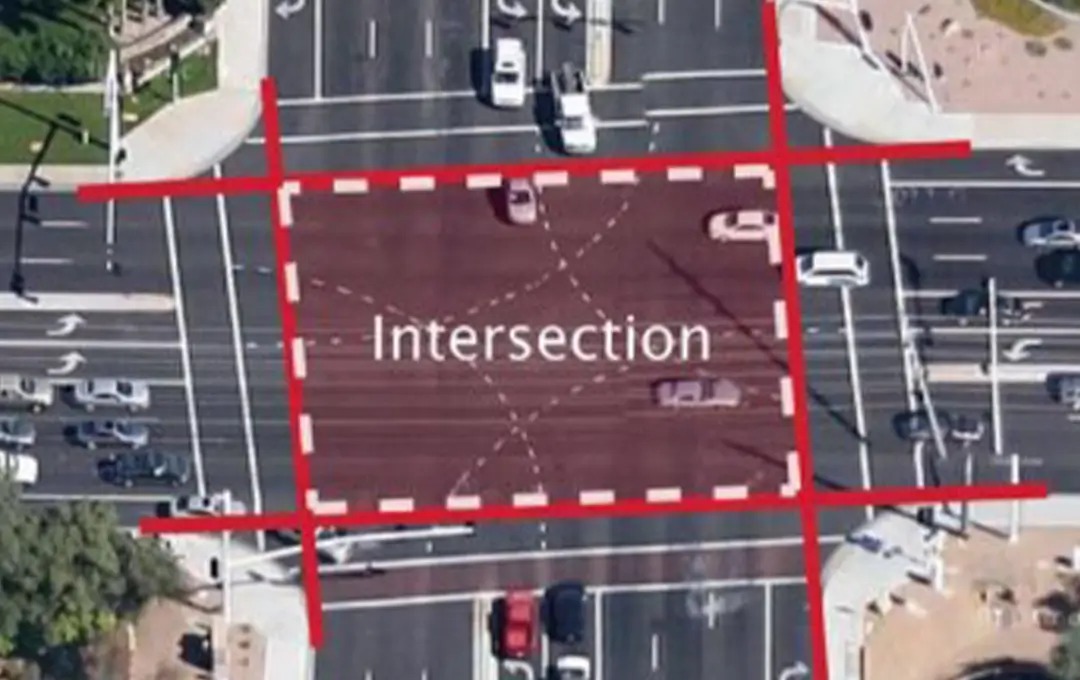
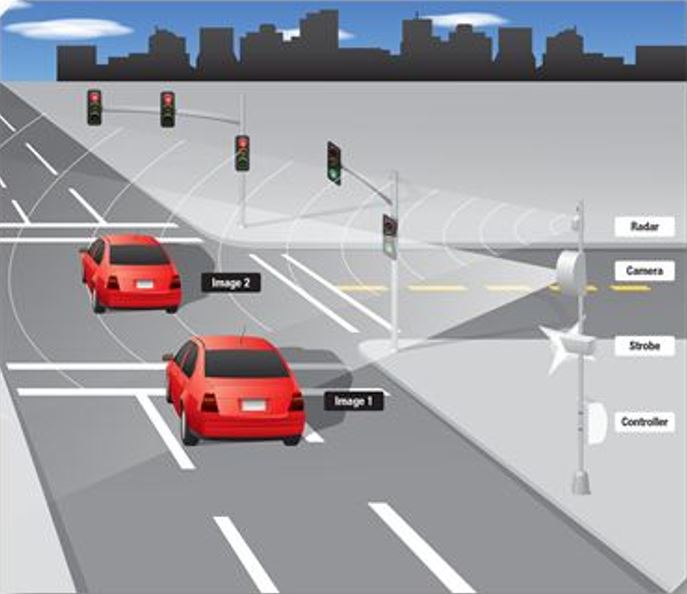
Illinois defines an automated red-light system around recorded evidence of a vehicle entering against a red signal. Under 625 ILCS 5/11-208.6, the record identifies the vehicle and plate and includes the event’s time, date and location. A photograph showing your car somewhere near a red light therefore needs context: which signal controlled your movement, where the vehicle was, and what happened next?
A right turn still starts with a complete stop
The Illinois Rules of the Road requires a complete stop and yielding before a permitted turn on red. “Right on red allowed” does not mean “rolling right turn allowed.” Review the approach, stop and turn as separate moments. A slowing vehicle can look stationary in one still image even though the full recording shows continuous movement.
The automated-enforcement statute also contains a specific limitation for a vehicle that completely stops without entering the intersection, subject to its pedestrian and bicyclist qualification. That provision is a reason to examine the actual sequence carefully, not a general instruction to cross a stop line. If the allegation concerns your stopping position, retain images that show the line, crosswalk, traffic and subsequent movement instead of relying on a description such as “I stopped eventually.”
A flash is different from a reviewed violation
A light flashing or equipment recording an event does not itself tell you the final administrative result. Illinois law provides for a review of the images before an automated allegation proceeds through the municipal system. Conversely, not noticing a flash does not establish that no record exists. Treat a mailed notice as the actionable document and use its evidence link and response date.
For identification questions before any notice arrives, our camera identifier helps distinguish an enforcement installation from a traffic sensor or monitoring camera. It cannot determine liability from a roadside recollection; the event record is what lets you test a particular allegation.
Identify the notice and the agency that can resolve it
Put the document on the table before choosing a website. A Des Plaines automated notice should identify the municipality, registered vehicle, alleged event and response instructions. An officer-issued traffic citation can instead direct the driver to the Circuit Court of Cook County. The city’s administrative-hearings information expressly separates moving violations heard in county court from municipal ordinance matters.
Read the following fields as a single identification check: issuer; notice or citation number; plate and registration state; location and direction; event date; alleged violation; response deadline; and the named hearing or payment office. A familiar vehicle is only one part of that match. For example, an owner might have a Des Plaines municipal notice and an unrelated Chicago parking balance. Paying one agency will not clear the other record simply because both use the same license plate.
Illinois’s automated-notice provisions call for the charge, event information, recorded images, penalty and response choices to be supplied. Use that structure to organize your paperwork. If the mailed notice and a later letter show different amounts, keep both and ask which stage the later demand represents. Do not replace the stated due date with a deadline copied from another suburb’s website.
Our official ticket website finder is a routing aid, not a government case search. Once you have identified Des Plaines as the actual issuer, follow its official link and the instructions attached to that notice. If the document names a court case, use the court’s own traffic services. This distinction also protects your personal details: a third-party search form does not become the correct place for a plate, card number or driver’s license simply because it appears above the government result.
Look up the notice and review the video before deciding
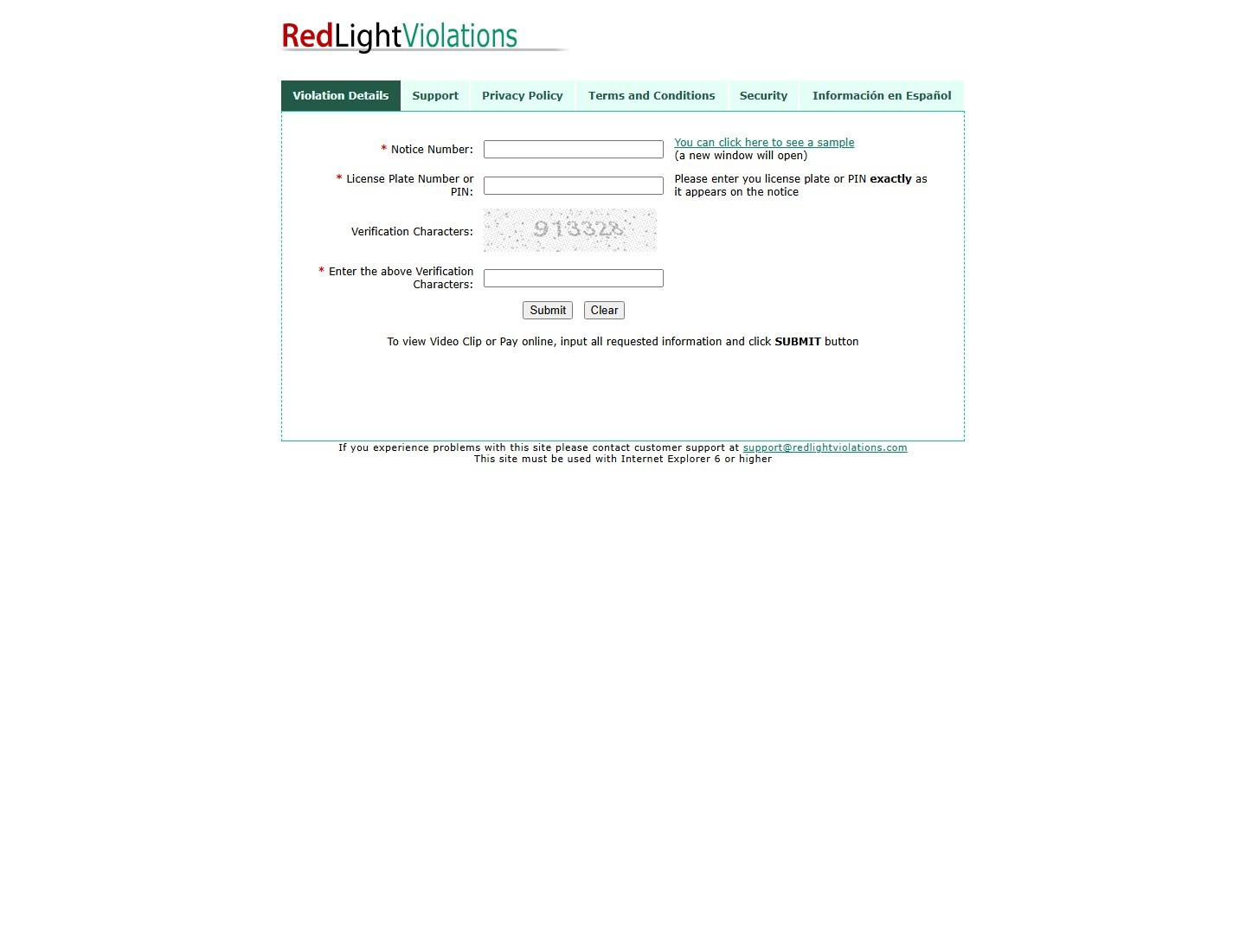
Des Plaines directs recipients to RedLightViolations for the recorded event and online payment. Open it from the municipal program page or the address printed on a verified notice. The portal is a service provider; a successful login does not turn its customer-service staff into the hearing officer who decides a disputed allegation.
Start with the municipal link and the notice details
Have the complete notice available and enter the requested identifiers exactly as printed. This is different from asking a general search engine to find every ticket associated with a plate. A notice number, plate details or another access field can be required. Follow the fields actually displayed for your record rather than borrowing another village’s instructions or guessing missing credentials.
If access fails, check that you have not confused a notice number with a payment reference or hearing number. Confirm the issuer and plate state, then contact the program using its official contact details. Record when you attempted access and what the error said. An unavailable video or unsuccessful search does not automatically stop the response clock, so ask how to protect a pending hearing request while access is being resolved.
Compare the full event with the allegation
Begin with identity: is it your vehicle and plate, at the recorded location and time? Then examine the movement. Watch the approach and turn, identify the controlled signal, and note where the vehicle stops or crosses into the intersection. Write a short factual chronology rather than deciding from the most flattering single frame. If an image is unclear, describe what cannot be established; do not manufacture a different event to fill the gap.
Save the available evidence, notice and your notes in one folder before choosing payment or a contest. Our RedLightViolations portal guide explains the general service and scam checks. The Des Plaines notice and municipal procedure remain the authority for this particular transaction.
Separate the civil penalty from a driver-record conviction
An automated red-light civil penalty and an officer’s moving-violation citation are different records. Illinois’s automated-enforcement statute says that its civil penalty is not recorded as a moving-regulation violation on the vehicle owner’s driving record. That distinction explains why the registered owner can receive a municipal notice even when the event was not handled as a roadside stop of that driver. It does not describe every red-light charge a police officer might issue.
Older local pages can also describe consequences that later state law changed. In particular, do not treat the city page’s older reference to suspension after five unpaid determinations as a statement of today’s debt-based licensing rules. Illinois’s 2021 statutory reform addressed suspensions for unpaid traffic and camera-ticket debt. A separate current license problem, however, still needs its own diagnosis; a civil camera balance does not tell you why a license record has a restriction.
Check the amount and response date on this notice
The posted Des Plaines determination provision describes a $100 fine and a later $100 late-payment penalty at the final-determination stage. Those are different items. A later $200 balance should therefore be compared with the notice history rather than assumed to be the original ticket price. Ask for an itemized explanation if the displayed amount does not match the documents you received.
The posted initial-notice provision uses a 14-day response period, while later determination provisions use their own stages and periods. Identify which document is in front of you before counting days. If a hearing has already occurred or a new decision arrived, use that decision’s instructions and confirm any discrepancy with the city. Our Illinois camera guide supplies broader context, but it cannot calculate an individual account’s current deadline or total.
Pay through the correct channel and keep proof
If you accept the allegation and choose payment, verify the record one last time before entering a card. The city-linked portal should show the same municipal issuer, vehicle and event as your document. Check whether the displayed total is the base fine or a later balance and review any transaction charge before authorizing it. A payment service’s convenience fee, if presented, is different from the municipal fine and should not be silently added to a published “ticket cost.”
Payment is a decision about the case, not simply a way to hold your place. Des Plaines’s posted notice provision describes payment as final disposition of the violation. If your aim is to contest liability, first use the hearing procedure and confirm the applicable instructions. Do not assume you can pay the fine now and automatically obtain the same merits hearing afterward.
- Open the official municipal link and locate the correct notice.
- Review the vehicle, violation details, current total and any processing terms.
- Complete the payment once and wait for the service’s result.
- Save the confirmation number, receipt, payment date and notice number together.
- Check the record’s later status and follow up if a new demand conflicts with the receipt.
If the page freezes after you submit, distinguish “no confirmation displayed” from “no transaction occurred.” Check the service’s record and your card’s pending activity, then contact support before making another attempt. A pending charge alone may not prove that the notice was credited, but repeatedly submitting the same payment can create a second problem. For mail or in-person options, use the payee, address and accepted method on the current notice; another suburb’s vendor mailing instructions are not interchangeable.
Prepare for a Des Plaines municipal hearing
If you dispute the allegation, request the available hearing procedure by the notice’s response date and retain proof of that request. The city describes administrative ordinance cases as using the civil preponderance-of-evidence standard: the question is whether the violation is more likely than not to have occurred. A focused explanation of the event and supporting records is more useful than treating the proceeding as an argument about cameras in general.
Match the stated defense to documentary evidence
Start with the proposition you want the hearing officer to accept. If the vehicle or plate was stolen before the event, supply the timely police report and the relevant dates. The posted municipal defenses provision expressly addresses theft and specified emergency-vehicle or funeral-procession circumstances. If your argument is instead that the images show another vehicle, identify the plate or vehicle mismatch clearly. General dissatisfaction with the fine does not establish either point.
Prepare a short chronology and label each attachment so it can be matched to a statement. Ask the administrator how photographs, recordings and other exhibits must be supplied. The city’s general hearing regulations restrict audio/video equipment in the room, so arriving with evidence only on a phone may not be a workable presentation plan. Confirm the accepted form before the hearing date rather than assuming the officer will search your device.
Nonresidents should also ask about the posted documentary-review procedure. The local code describes submitting evidence with a notarized statement of nonresidency by the hearing date. That is a defined alternative with conditions, not permission to send an informal email whenever convenient. Keep the request, submitted material and confirmation together.
Distinguish a camera hearing from an officer-issued court case
The Cook County Clerk’s e-Citation service includes Des Plaines moving citations but explicitly excludes camera and parking violations. That is why an unsuccessful county search does not dispose of a municipal notice. If an officer also issued a citation for an event, keep the two documents separate and ask the appropriate authority how each must be answered.
A hearing request is not the same as a favorable decision. After the proceeding, obtain the written result, any payment instructions and the stated review route. Read each document promptly; neither a pending support question nor your memory of an oral discussion should replace a formal decision’s instructions.
Confirm the outcome and handle a missing or unresolved record
The useful end point is a municipal record that agrees with what happened: payment credited to the correct notice, a written finding after a hearing, or a documented correction. Keep the original notice, evidence, submissions, result and receipts until that agreement is clear. A card statement without a notice number can be harder to trace than the payment service’s actual confirmation.
For an unanswered procedural question, the city directs police-related administrative-hearing inquiries to Police Records through its official hearing page. Explain which document you received and what you need confirmed: access to images, the proper response form, a credited payment or the status of a decision. Keep that question separate from the act of formally requesting a hearing. Asking for help does not establish that a required filing was received.
If a determination arrived after you already paid or after you missed a hearing, act on the new document promptly. The posted code provides a time-limited petition process with specified grounds and a review by a hearing officer; it is not an unlimited opportunity to reopen any old case. Supply the receipt or explanation that addresses the actual error and ask the administrator for the current applicable procedure. A new hearing is not guaranteed merely because a petition was sent.
For a driver researching a camera without any notice, the next action is different: verify the documented intersection, direction and operational date. For an owner with a notice, the next action is to inspect the event and answer the correct issuer by the applicable deadline. Keeping those two questions separate prevents an uncertain map marker, an outdated webpage or a different city’s payment system from deciding what happens to your account.



Loading comments...