Hoffman Estates, Illinois | Municipal red-light notices
Hoffman Estates Red Light Cameras: Locations, Tickets and Hearings
Read the listed approaches, review the recorded event and use the village's own payment or adjudication process.
Hoffman Estates publishes its camera locations, but resolving a ticket requires more than spotting the right intersection on a map. The direction, alleged movement, Notice number and response instructions all matter. This guide brings the village's program and notice pages together while preserving an important distinction: a camera capture, a mailed allegation and a hearing decision are separate stages. Start with the issue you need to solve, whether that is identifying an approach, viewing an event or answering a particular notice.

Read the village's camera list by approach
The Hoffman Estates program page lists nine red-light cameras at five intersections. Those numbers describe different things: an intersection is a crossing, while a listed approach is a direction from which traffic reaches it. A map with five pins can therefore represent nine monitored approaches without either count being wrong.
| Intersection | Village-listed approaches |
|---|---|
| Higgins Road and Barrington Road | Eastbound, westbound and southbound |
| Roselle Road and Higgins Road | Northbound |
| Golf Road and Sutton Road | Southbound and eastbound |
| Golf Road and Barrington Road | Westbound |
| Golf Road and Bartlett Road | Eastbound and westbound |
Use the exact road pair and direction when checking an event. At Barrington and Higgins, for example, the official FAQ names southbound Barrington and eastbound/westbound Higgins. That does not establish a northbound Barrington camera. Nor does a device facing a roadway necessarily monitor every lane or movement that can be seen from its pole. The notice's recorded direction and alleged movement provide the next level of detail.
The village also warns that maintenance and construction can take the system out of service. Treat the list as a municipal program reference, not a live uptime dashboard. For a claim that equipment was inactive on a specific day, obtain date-specific information rather than relying on an undated screenshot. Our camera map can help orient a trip, while the municipal record and notice should be used to identify an actual allegation.
Understand red entry, right turns and camera flashes
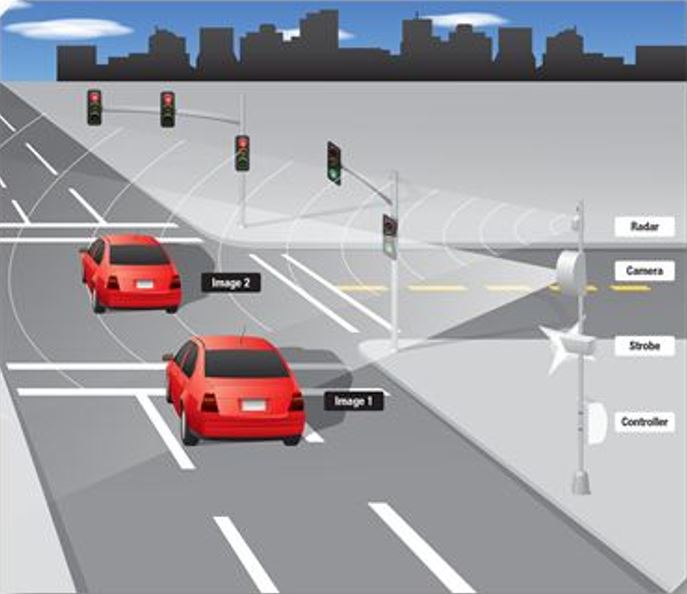
Hoffman Estates describes a sequence of image capture followed by review. Its camera FAQ discusses two rear images, signal timing information and a short event video. Police make the decision to issue a notice. A flash can occur when a vehicle ultimately stops, so the flash alone does not establish the result of that review.
Entering after red is different from clearing an intersection
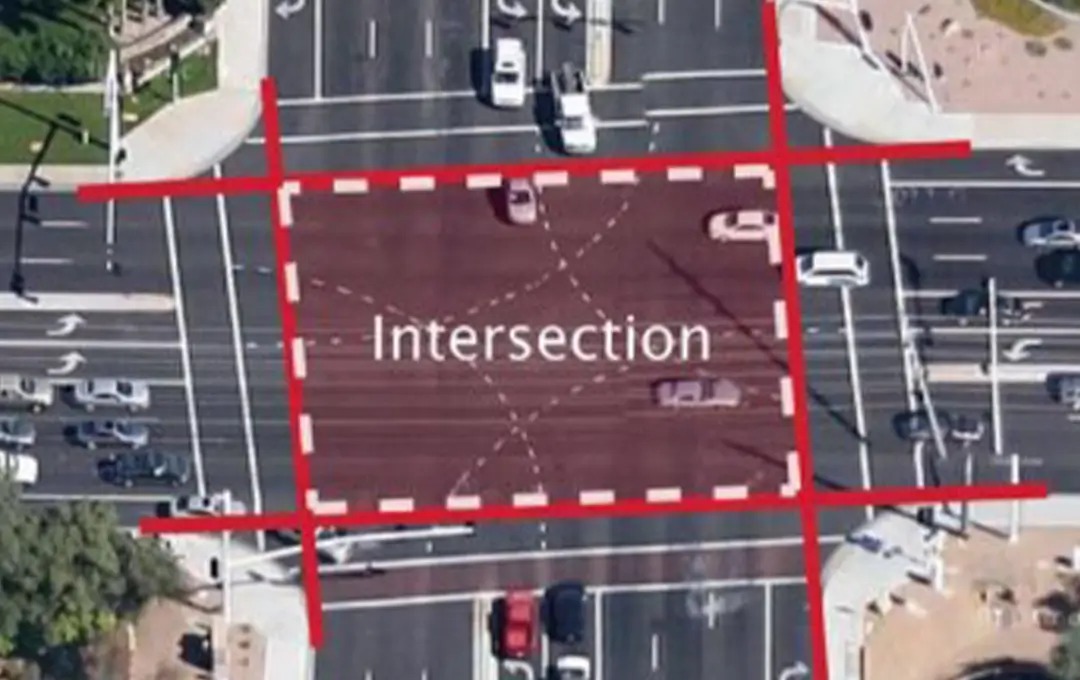
The village distinguishes a vehicle entering after the signal turns red from one already inside the intersection waiting to finish a movement. Its example is a driver who entered on green and completes a left turn when oncoming traffic clears. The later red signal does not transform the earlier lawful entry into a red-entry event merely because the vehicle remains visible in the crossing.
That distinction makes the recording's sequence more useful than a single still. Identify the point of entry, the signal controlling that lane and the vehicle's later path. It remains necessary to yield and obey other intersection rules; the example is not a blanket permission to enter when there is nowhere safe to go. If the notice alleges red entry, explain the timing issue with images that address entry rather than an unrelated argument about how long the light stayed red.
Check the village's right-turn statement before generalizing
The main program page specifically says the village's cameras will not capture images of right turns where right turns are not prohibited. The FAQ's broader explanation of flashes also discusses a vehicle slowing through a right turn. Read those statements carefully rather than converting the FAQ into a claim that every rolling right turn currently receives a Hoffman Estates notice.
A camera-selection policy does not remove the underlying duty to stop and yield before a permitted turn on red. If a notice appears inconsistent with the published policy, compare the actual movement and signs, preserve the evidence and ask the municipal program to explain the allegation. Use the stated contest process by its deadline rather than declaring the record invalid yourself. Our red-light camera explanation provides general mechanics; the local policy and recorded event answer the local question.
Use your Notice number and PIN to view the event
For Hoffman Estates, the village directs recipients to ViolationInfo. Its notice instructions identify the Notice number and PIN in the red box at the upper right of the front page. These are event-access credentials, not an invitation to search all tickets nationally using only a license plate.
Open the service from the village page and compare the issuer and event with the paper before proceeding. The same provider serves many communities, and instructions displayed for a different city can have different payees, deadlines and hearing arrangements. If the record does not appear, recheck the credentials and contact the program rather than assuming the notice has been canceled. For a person without home internet, the village suggests using public-library internet access to view the material.
What to compare in the images and video
Review the plate and vehicle first, followed by the road pair, recorded approach, date and time. Then watch the movement and signal sequence. The village says the evidence is reviewed by technicians and the Police Department before mailing, but that review does not remove the recipient's right to challenge an error. Your explanation should identify what the recording actually shows or fails to establish.
A useful note is specific: which image shows entry, which signal governs that lane, and which detail conflicts with the allegation? “The camera flashed at another car” is a recollection; a clear plate mismatch or a sequence showing your entry before red addresses the record. Save the notice and available evidence before choosing an option. Our ViolationInfo video guide explains the general viewing workflow while the village's notice supplies the local procedure.
Calculate the ticket balance and choose a payment method
The village's notice page lists a $100 fine per offense. It also publishes a $4 convenience fee for online or telephone card payment. These are separate charges: the municipal penalty is not the same thing as the service cost of a chosen payment method. Check the notice and the final payment screen for the amount that applies to your transaction, especially if a later notice or additional balance is involved.
| Published channel | What to have ready |
|---|---|
| Online through ViolationInfo | Notice number, PIN and accepted payment details; review the disclosed fee |
| Telephone: 866-790-4111 | The correct notice; the village lists a convenience charge for card payment |
| Check or money order by mail | Current notice coupon, named payee and payment envelope; include notice and plate identifiers |
| Police Department payment drop-off | 411 W. Higgins Road; confirm current business hours and accepted method |
Do not confuse a payment envelope with a declaration envelope. The official instructions provide different destinations for those activities, and mailing supporting documents to the payment-processing address is not a reliable way to request adjudication. Follow the form and address attached to the action you are taking. The village's mail instructions specify a check or money order and say not to send cash.
The first notice includes a scheduled hearing date, which the village locates at the top and bottom right. Its published instruction is that payment before that hearing date removes the need to attend for the paid notice. That does not resolve another ticket or a separate court case. Save a receipt containing the notice number and check that payment was credited. If you intend to dispute liability, understand the hearing option before treating payment as a temporary way to avoid thinking about the allegation.
Decide how to contest the allegation
Hoffman Estates says a hearing request must be made in writing on or before the notice's due date. Its notice page explicitly says requests cannot be made by phone. A conversation with a payment-service representative can help solve access problems, but it should not be treated as proof that an adjudication request was filed. Keep a copy of what you submitted and how it was delivered.
Attend the scheduled administrative hearing
The village identifies the Police Department at 411 W. Higgins Road as the hearing location and directs the recipient to the date and time printed on the notice. Use that assignment rather than simply arriving at a police counter when convenient. If a scheduling problem arises, ask about the procedure before the date and obtain confirmation of any change.
Bring the notice, a concise statement of the issue and documents that address it. You may bring a lawyer according to the village's instructions. The same page says only the recipient may appear, so do not assume a friend can attend in your place or that an attorney's involvement automatically excuses personal attendance. Confirm the requirements for your situation with the hearing administrator. Chicago's virtual-hearing options should not be assumed to exist in this separate municipal system.
Submit the appropriate declaration and supporting documents
The published alternative to attending is to complete the Declaration of Non-Liability and submit the documentary evidence for review. The village says those documents must be received before the date on the notice and that the outcome will be mailed. Download the form associated with your notice and follow its current instructions; an informal account of what happened is not necessarily the required declaration.
Make the evidence easy to follow. State the particular issue, identify the recording frame or document that supports it, and connect dates and vehicle identifiers where ownership is disputed. Keep delivery confirmation and a full copy. Documentary review is still a decision-making process, not an automatic cancellation because a form was returned. For the broader difference between municipal and county proceedings, see our Cook County camera-ticket guide.
Deal carefully with another driver, a sale or a lease
A Hoffman Estates automated notice is assessed against the vehicle owner rather than established by a roadside identification of the driver. The village says its camera process does not need a photograph of the driver's face. Consequently, “someone else borrowed the car” and “I did not own that vehicle at the relevant time” are different statements. Explain the actual circumstance and use the procedure that addresses it.
The notice instructions describe an affidavit route for specified situations, including a sold vehicle or plate, a deceased registered owner, or a police citation for the same violation. Obtain the current form through the notice's service link and attach the document that establishes the relevant event and date. A bill of sale, for example, must connect the identified vehicle to the claimed transfer; a vague statement that you “sold a car around then” leaves the central question unresolved.
For a leased or rented vehicle, keep the agreement, possession dates and any rental-company correspondence. Illinois law has specific treatment for lessors and lessees, and the name that first receives mail may not end the inquiry. Ask the municipal program what it needs rather than assuming a rental company's separate administration charge paid the municipal fine or completed a required declaration.
Where an officer also issued a citation, preserve that document and ask how the same-event issue should be presented in the camera proceeding. Do not discard the court paper because you sent an affidavit about the automated notice. Similarly, disputing who owned or controlled the vehicle is not the same as correcting an obvious plate-reading error. State the issue precisely, submit truthful records and keep the written result so that all relevant parties can tell which notice was actually resolved.
Keep camera liability separate from court and driving records
The village describes its automated notice as a civil, nonmoving matter with no driving-record points. Illinois's automated-enforcement statute provides the relevant distinction from a recorded moving violation. This is why a municipal owner-liability notice should not be analyzed as though an officer had stopped and charged a particular driver.
The distinction does not mean every document involving a red light has no record consequence. A separate officer-issued moving citation belongs to a different process, and a person's existing driving restriction can have an unrelated cause. Keep the actual documents together while treating the charges separately. A statement about the automated notice cannot resolve a court case, remove an unrelated suspension or predict every insurer's handling of a broader driving history.
The village's older notice wording also refers to possible license suspension for nonpayment. Read that alongside the later Illinois debt-suspension reforms, including the July 2021 changes. Repeating an old webpage without that context can exaggerate the current licensing consequence. It remains necessary to respond to the civil balance and notices; avoiding an outdated suspension claim is different from promising that an unresolved debt disappears.
A county traffic search is not a municipal camera lookup
Cook County's e-Citation program lists Hoffman Estates among participating municipalities for certain moving citations, while explicitly excluding camera and parking violations. A driver can therefore find an officer-issued ticket there without finding a Hoffman Estates automated notice. A “not found” result in the county service is not evidence that the village notice was dismissed.
Route the document by its named forum: municipal camera access and adjudication for the automated notice, the assigned court for a court citation. Our ticket website finder helps identify that starting point, but the agency's own record establishes the case status.
Use the statistics and follow-up record for the question they answer
The village publishes approach-specific statistical material using intersection-related police crash records. Its explanation describes before-and-after periods and cautions that reduced traffic during 2020–2021 affected crash counts. Installation and reactivation dates help interpret those comparisons; a chart is not a minute-by-minute report of whether a camera is operating.
If you are assessing safety, compare the same approach and crash categories over clearly identified periods. A change in the number of crashes can also reflect traffic exposure, construction or other conditions. It should not be turned into a personal promise that a particular road is safe or a conclusion that one camera alone caused every change. For a specific operating-status question, ask the village about the approach and date; the main program page lists 847-781-2846 for further information.
If you are checking an account, the evidence is different: notice number, event date, payment receipt and written hearing result. The village says a later letter may concern another event or may cross a payment in the mail. Its notice page allows that a mailed payment can take as many as ten business days after reaching the payment office to appear in the system. That processing explanation is not a new extension of a hearing or response deadline.
Compare the old and new notice numbers before paying twice. Contact the published customer-service number, 866-790-4111, with the transaction details if the account does not agree with the receipt. After a contest, retain the mailed outcome and follow its instructions. The aim is a record that shows what happened to the particular notice, rather than a screen or conversation that merely suggests someone looked at it. Our Illinois program guide can help with regional context while you keep this municipal record distinct.



Loading comments...